




Full-funnel marketing is one of those concepts that feels familiar until you try to explain it clearly. Most teams agree it matters. Fewer agree on what it actually includes. Even fewer can point to a version that reflects how shoppers behave today.
That gap exists because the funnel itself has changed. People no longer move cleanly from awareness to consideration to conversion. They discover brands across social, the open web, retail environments, and video. They research in fragments. They return when timing, context, or need shifts.
A modern full-funnel strategy has to reflect that reality, not the diagrams we have been using for years.
What a full-funnel strategy is in marketing
A full-funnel strategy in marketing is the practice of connecting awareness, consideration, and conversion efforts across channels so that each stage reinforces the next. It brings commerce media, performance media, and retail media into a single operating model. It relies on shared data, consistent messaging, and continuous optimization rather than isolated campaigns. When executed well, it supports both short-term performance and long-term growth.
That definition matters because it frames full-funnel marketing as a system, not a checklist. The goal is not to run more campaigns. It is to design how demand is created, nurtured, and converted over time.
To make that concrete, it helps to look at how each stage actually functions today.
How the funnel works in practice
Rather than rigid steps, funnel stages now describe different jobs that marketing needs to do simultaneously.
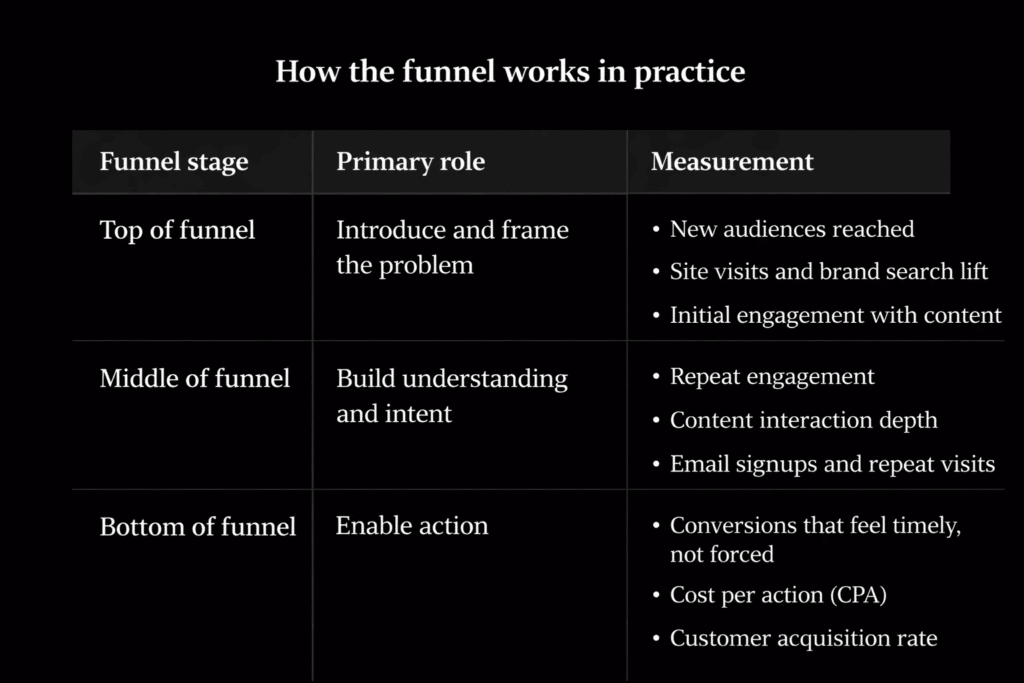
This structure still holds, but the execution is no longer linear. Someone might enter at the middle, drop back to the top, and convert weeks later through a different channel. A full-funnel strategy accounts for that movement instead of fighting it.
Why top-of-funnel measurement causes so much friction
One of the most common questions teams ask is how to measure top-of-funnel impact. The challenge is not that top-of-funnel activity lacks value. The challenge is that its value shows up later.
Awareness work rarely produces immediate conversions. Its role is to introduce a brand, establish relevance, and make future messages easier to process. When teams rely only on last-click attribution, those contributions disappear from reporting.
A more realistic approach looks at influence rather than final action. Signals like brand search lift, reach among new audiences, repeat site visits, and downstream conversion behavior provide a clearer picture of how early exposure shapes later decisions. Incrementality testing adds another layer by showing what would not have happened without that initial touch.
This does not make measurement perfect. It makes it honest.
Where platforms fit into full-funnel execution
Another frequent question is how DSPs support full-funnel advertising strategies. The answer is less about the label and more about capability.
A platform supports full-funnel execution when it helps unify reach, intent, and conversion across environments instead of optimizing each stage in isolation. That means enabling discovery at scale, supporting consideration through consistent exposure, and activating high-intent audiences when action is most likely.
Commerce signals play a critical role here. Unlike broad demographic or interest data, commerce data reflects real shopping behavior. When those signals inform targeting, bidding, and creative decisions, campaigns can adapt as people move across the funnel.
AI becomes useful in this context not as a talking point, but as an operational layer. It helps systems respond to behavior without requiring constant manual intervention.
Cross-channel does not mean scattered
A common mistake in full-funnel planning is equating cross-channel with being everywhere. Presence alone does not create impact. In fact, spreading messages across too many disconnected touchpoints often creates the opposite result.
Fragmentation is the real risk.
When teams run awareness, consideration, and conversion efforts in isolation, shoppers experience the brand as inconsistent. Messages reset from channel to channel. Signals are lost. Performance becomes harder to explain, not easier.
The purpose of a full-funnel strategy is to avoid that fragmentation. Each stage should build on what came before it, even when it happens in different environments. A shopper might discover a brand on the open web, return through social, and convert in a retail context. What matters is that the experience feels connected rather than disjointed.
This is where a cross-channel approach becomes foundational to full-funnel execution. When discovery, intent, and conversion are managed through a shared system, messaging stays coherent and signals carry forward. The funnel works as a continuum rather than a series of restarts.
Why full-funnel strategies keep evolving
Full-funnel marketing continues to evolve because shopper behavior continues to evolve. People move fluidly across channels, devices, and moments. They do not distinguish between brand and performance in the way internal teams often do.
As a result, full-funnel strategies increasingly depend on cross-channel execution to stay effective. Connecting commerce media, performance media, and retail media allows teams to respond to how people actually shop rather than forcing them into predefined paths. Video, display, social, and retail environments become complementary instead of competitive.
This evolution also changes how teams operate. Strategy shifts from constant manual optimization to system design. AI-driven optimization helps campaigns adapt as intent changes, while unified measurement reduces blind spots across the funnel. Over time, this makes full-funnel marketing more resilient. It scales without becoming fragmented. It supports growth without sacrificing efficiency.
The strongest full-funnel approaches are not static frameworks. They are adaptive systems built to reflect real behavior across channels and over time.
Frequently asked questions
What is a full-funnel strategy in marketing?
A full-funnel strategy in marketing connects awareness, consideration, and conversion across channels so each stage supports the next. Rather than treating these stages as separate efforts, it uses shared data and consistent messaging to reflect how people actually discover, evaluate, and choose products or services. The goal is to balance short-term performance with long-term demand creation.
How do you measure top-of-funnel impact?
Top-of-funnel impact is measured by influence rather than immediate conversions. Common signals include reach among new audiences, brand search lift, repeat site visits, and downstream conversion behavior. Incrementality testing helps determine what would not have happened without early exposure. Together, these signals provide a clearer view of how awareness contributes to later performance.
How can DSPs support full-funnel advertising strategies?
DSPs support full-funnel advertising strategies when they enable unified execution across awareness, consideration, and conversion. This includes reaching new audiences at scale, maintaining consistent exposure as intent builds, and activating high-intent users when conversion is most likely. When powered by commerce data and AI-driven optimization, DSPs help campaigns adapt as shoppers move across the funnel.
If you are exploring how to run campaigns that connect awareness, consideration, and conversion across channels using commerce-driven signals, you can learn more here.