How Commerce Intelligence Works
You can think of it as part conductor, part operating system for commerce: harmonizing many moving parts while providing the underlying logic that guides action in real time. That orchestration depends on a few core elements, each helping businesses understand, decide, and act across the shopping journey.
Commerce data at scale
As we explained earlier, this is the data that captures what shoppers are actually doing: what they search for, compare, save, revisit, and buy, along with the product and media signals that shape those decisions. Those signals typically fall into four categories:
- Shopper signals such as product searches, add-to-cart activity, purchases, browsing behavior, wishlist additions, and AI assistant conversations.
- Product signals such as pricing, availability, inventory, shipping, reviews, ratings, and catalog data.
- Media signals such as page content, ad engagement, and seasonality.
- User timelines: Signals mapped across the path to purchase.
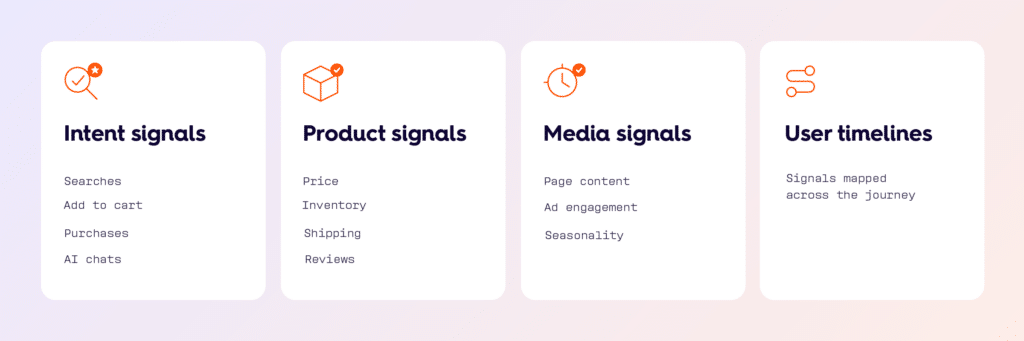
When deep learning is applied to these signals, disparate data points become a cohesive view of intent—one that encompasses both deep shopper and product understanding. Commerce intelligence can recognize what a product is, how demand shifts over time, which items are often considered together, and what behaviors suggest someone is moving closer to a purchase.
Instead of leaning on broad demographic assumptions, commerce intelligence learns from behavior in motion. It pays attention to sequences, not just isolated events, so it can detect when casual browsing starts to look like real intent.
For example, someone who briefly glances at a desk once may just be browsing. But someone who compares standing desks, reads ergonomic chair reviews, searches for “home office setup,” and comes back repeatedly is sending a much clearer signal. Commerce intelligence recognizes that pattern and updates its understanding as the journey evolves.
AI decisioning
If commerce data is the fuel, AI decisioning is the engine. It uses its understanding of intent to make decisions across discovery, consideration, conversion, and loyalty, such as:
- Which audience to prioritize
- Whether a bid is worth placing, based on intent and campaign goals
- How much to bid
- How to balance paid and organic listings on retailer sites
- Which products to recommend
- Which ad creative or message to show
- When to suppress ads for recently purchased products
- How to sequence experiences across channels
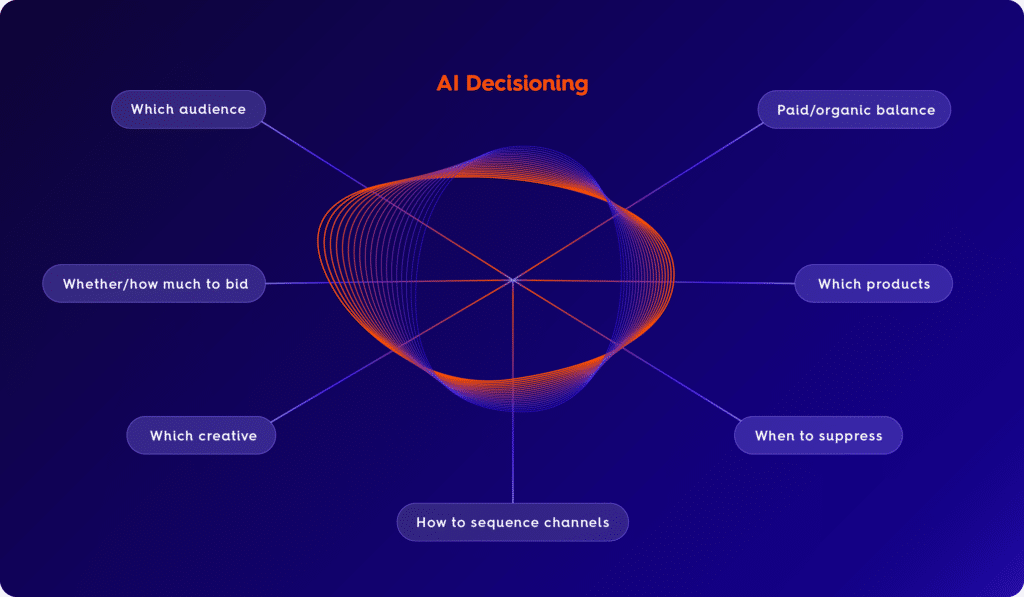
Powering this behind the scenes is a complex system designed to understand relationships between products, shoppers, queries, context, and outcomes. That commerce understanding helps the system evaluate options, predict likely outcomes, and choose the next best action as conditions change.
In practice, this means making a chain of connected decisions in milliseconds. When a shopper visits a page, performs a search, or interacts with an AI assistant, the system interprets intent, identifies relevant products or audiences, estimates likely engagement, weighs competing priorities, and decides what experience to deliver next. Each choice shapes what the system learns afterward, so decisioning is continuous.
Rather than treating every impression or interaction the same, commerce intelligence helps businesses decide where, when, and how to engage with a much better sense of what is likely to matter in that moment, for more efficient growth.
Cross-channel coordination
A single shopper moves between retailer apps, ecommerce sites, streaming environments, social platforms, publisher content, physical stores, AI assistants, and connected TV. Commerce intelligence observes those touchpoints and connects them — coordinating activation, measurement, and optimization across channels and surfaces.
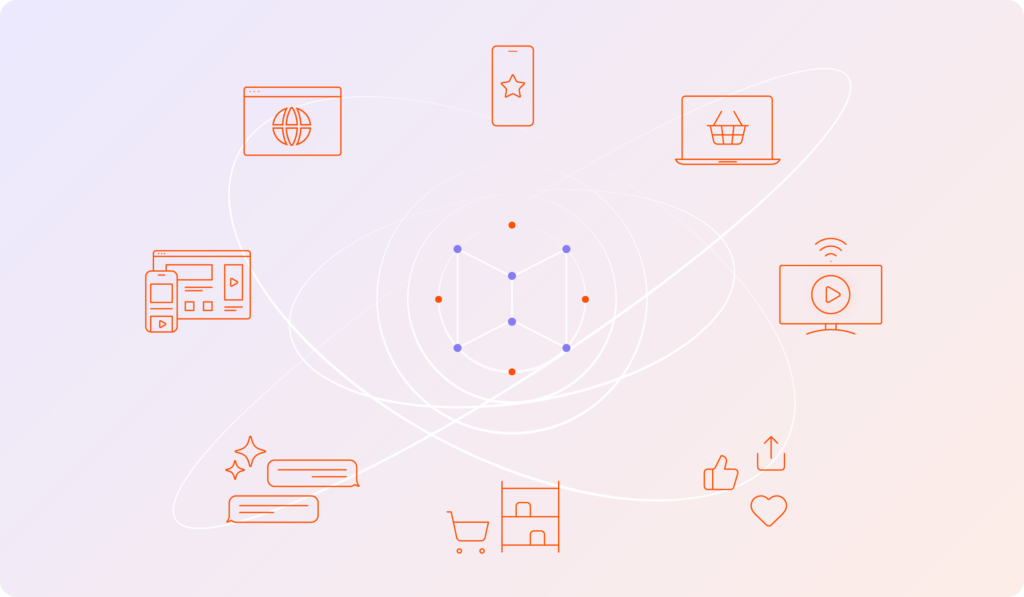
That coordination helps businesses reduce waste, improve performance, and create experiences that feel more relevant and less repetitive.
Understanding fragmented journeys
Commerce intelligence also helps businesses understand what’s happening throughout a fragmented journey. That starts with identity and data connectivity. When a shopper moves from mobile to desktop, from a retailer app to a publisher site, or from a product search to an AI assistant conversation, each interaction can look disconnected. Commerce intelligence helps connect those signals where they can be recognized in privacy-conscious ways, creating a clearer view of the same shopping journey across devices, environments, and sessions.
This does not rely on a single identifier or one universal solution. As third-party cookies and other legacy identifiers become less reliable, addressability increasingly depends on a mix of privacy-safe signals and connection methods. These can include first-party data, hashed emails, logged-in signals, first-party cookies or visitor IDs, alternative IDs, contextual signals, clean room integrations, retail media networks, and privacy-preserving browser APIs.
Commerce intelligence uses these inputs to build a more durable understanding of intent. Some may be deterministic, such as when a shopper is recognized through a logged-in or hashed first-party signal. Others may be modeled, based on patterns across behavior, context, product interest, and outcomes. Together, these signals help businesses recognize when separate moments may belong to the same journey, even when that journey spans different devices, publishers, retailers, and platforms.
Instead of evaluating every touchpoint in isolation, businesses can see how different interactions work together: which moments sparked discovery, which product signals increased consideration, which messages moved someone closer to purchase, and where spend or repetition added little value.
A shopper might discover a blender through a social video, compare models in a retailer app, read reviews on a publisher site, and later ask an AI assistant which option is easiest to clean. In a siloed system, those moments may appear as separate events. With commerce intelligence, they become part of a larger pattern that helps explain what influenced the decision and what action should come next.
Commerce intelligence also makes holistic measurement possible by bringing together data from the systems where commerce activity is planned, activated, and measured. That can include DSPs, CDPs, CRMs, clean rooms, retail media networks, publisher platforms, and analytics environments. Commerce intelligence helps connect these inputs so businesses can compare performance across channels, link media exposure to commerce outcomes, and understand how different touchpoints contribute to discovery, consideration, conversion, and loyalty.
The result is a feedback loop: connected identity, commerce signals, and measurement systems improve understanding, understanding improves decisioning, and better decisioning improves outcomes over time.