






DTC brands have more tools, more channels, and more data than ever. The tactics that were once differentiators – performance marketing, influencer partnerships, subscription models – have become table stakes, making it harder for brands to stand out on tactics alone.
When customer acquisition costs rise across channels, and auction pressure increases, growth stops being about buying more traffic and starts being about driving higher-quality demand.
The brands emerging as winners share a common trait: they treat first-party consumer data as a strategic asset. They use it to shape product development, guide geographic expansion, and power marketing rooted in real audience engagement.
Most importantly, growth today isn’t driven by brands that shout the loudest, but by the brands that are clearest about what they stand for and who they’re for. While reach still matters, precision beats volume. For brands to cut through and stand out, it’s about demand accuracy over scale.
In the attention economy, DTC brands that don’t stand out will quickly find themselves adrift in a sea of sameness.
Here’s how to avoid that fate.
What outperforming brands are doing differently
Let’s look at what’s actually working for the brands that cut through and stand out.
Turning data into differentiation
While privacy changes have reshaped targeting models, they’ve also created an advantage for brands with direct customer relationships.
While the shopper journey is becoming more fluid and fragmented, expectations for relevancy and personalization keep rising. DTC brands have an edge: rich first-party data from onsite engagements like category searches, product interactions, transactions, as well as in-store purchases.
Taking the latest technology trends into account, brands that consistently collect and connect their first‑party signals can leverage new AI solutions to generate deeper consumer understanding. Grounded in those insights, brands can take personalization to the next level.
We see this impact first-hand. Brands that activate their product and first-party consumer data can segment smarter and engage the right consumer with more precision – driving higher relevance, and a better shopper experience. Conversion reaches double digit growth.
Using AI to unlock deeper consumer insights
Brands that are still relying on guesswork informed by a thin layer of customer data are quickly being lapped by brands making use of AI’s increasingly powerful prediction algorithms.
AI models trained on real purchase behavior, not just clicks or page views, can now spot intent signals that traditional segmentation completely misses such as:
- Which customers browsing your website are actually converting and why.
- Which acquired customers stick around vs. churn in three months.
- Where your best lookalike audiences are across the open web, not just inside the platforms you’re already buying.
The catch is that this only works with commerce data at scale.
Social and search can tell you what people are interested in. Transaction data enriched with AI tells you what they actually buy and what they are likely to buy in the future.
For example, one major European fashion platform analyzes millions of data points from wish lists and baskets to identify not just what’s selling, but what’s about to sell, then combines these insights with human expertise to forecast emerging fashion trends.
Your brand’s ability to use AI to unlock deeper insights becomes even more critical as Gen Z and Gen Alpha come to the fore. Both generations are product-driven rather than being brand-loyal. They expect personalization and 40% of them are already using AI to shop.
Simply put, your brand needs to meet them with the same sophistication or risk losing them to brands that do.
Diversifying media spend with a consumer-first approach
With consumers spending more time online where discovery, research, and purchasing happens across a wide range of touchpoints (across websites, apps, social feeds, connected TV, and increasingly, using Agentic commerce) – the consumer journey is more fluid than ever.
Activate Consulting estimates in their Technology & Media Outlook 2026, that online shoppers use an average of 4.8 sites or apps during product inspiration and research.
Consumers also switch between online and offline based on convenience, value, trust, and experience rather than loyalty to one buying path.
Brands that realize this are spreading their media investment accordingly – moving beyond the big three platforms that dominate their budgets to meet their consumers wherever their journeys take them.
What matters isn’t just reach, it’s context. Engagement looks different in content mode than in scroll mode, and the open web tends to reward brands with genuine stories to tell.
Brands are rethinking marketing tactics from a channel-first approach to a consumer-first one.
While the idea is simple, to meet customers where they are, the advantage comes from the holistic orchestration: Dynamically allocate and optimize budgets across channels so that every impression feels timely, relevant, and intentional.
Building community to drive loyalty and growth
For DTC brands, experience and storytelling increasingly matter more than price. Consumers don’t just buy products, they align with brands that reflect their values, interests, and identity.
Being part of a like-minded brand community is a top driver for creating emotional connection to a brand. Brands that show up in the real-world moments that matter, like events, running clubs, or experiential spaces, move beyond transactions and into meaningful participation.
Digital extensions such as exclusive access, member benefits, and personalized experiences deepen that relationship and create ongoing value.
When done well, community becomes a growth engine. Engaged members purchase more frequently, adopt new launches faster, and are less price sensitive.
Most importantly, they become advocates and recruit new customers through word-of-mouth, social content, and shared experiences.
Influencing across the full funnel
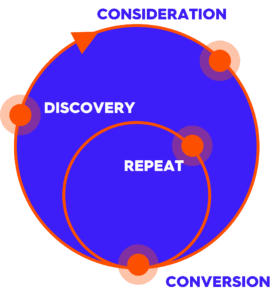
The traditional marketing funnel treats discovery and consideration as separate stages. But a clear pattern is emerging among DTC winners: they’re unifying the two into one connected approach where context and influence are King.
From a consumer perspective, it’s intuitive. People move fluidly between discovery and consideration, and they rarely convert in the same place they first found a brand.
The strategy itself hasn’t changed: reach new-to-brand audiences, convert them into first-time customers, and turn those customers into loyal repeat purchasers. The difference lies in execution, running a unified approach across the funnel.
Think influence at the right contextual moment. Video that captures attention and delivers emotional storytelling to shape purchase decisions. Think relevancy. The right product, with a resonant message, delivered at exactly the right time.
It’s a personalized approach vs. a one size fits all. Because consumers shop differently. And thanks to generative AI, this level of personalization is possible at scale.
The AI-powered commerce media opportunity (and what it means for DTC)
The next phase of DTC growth won’t be won by the brands focused on the largest reach, but by the ones that can turn intent into outcomes and stand out when customer attention is fragmented across channels.
The fragmentation increases complexity for marketers, but it also creates a clear opportunity: commerce media is emerging as the performance layer that helps brands show up wherever shopping decisions are influenced, with measurement tied to real business outcomes.
This is where commerce media stands out, because it brings a unified intelligence layer to a disconnected ecosystem.
In 2026, the brands that stand out will pair storytelling with a commerce intelligence engine that makes every impression feel intentional.
The intelligence layer
Commerce media connects marketing to the signals that matter most: what people actually buy (and are most likely to buy next).
It combines first-party commerce and intent signals with AI decisioning, applied at scale across massive commerce datasets spanning billions of shoppers, trillions of transactions, and billions of products.
What makes it fundamentally different is how advanced AI finds intent signals in complex and unlinked data sets. AI can predict purchase intent, personalize creative and product selection in real time, and optimize across channels while adapting to a world with fewer tracking signals.
For DTC brands looking to differentiate, this becomes a genuine edge. Your first-party data becomes training data for AI models that improve over time. Your campaigns reach shoppers at high-intent moments. Measurement connects directly to commerce outcomes, not just clicks.
It’s differentiation through intelligence and influence. It’s how brands stand out.
The differentiation playbook for 2026
Enough scene-setting. The opportunity is clear, so now let’s talk about how to seize it.
Step 1: Audit your concentration risk and diversify across channels
Start by pulling your media spend reports. If more than 70% of your budget is concentrated in two or three platforms, you’re paying the sameness tax – competing in the same auctions as everyone else, bidding up prices and bidding down differentiation.
Concentration is only half the story. The bigger question is where diversification will have the most impact: Where does your brand want to stand out? Map the journey from discovery to purchase and identify moments for inspiration, no matter the stage they’re in. Think about what to communicate where.
Pressure-test the economics. Track CAC trajectory honestly. If it’s rising faster than customer lifetime value, the current approach has a shelf life. Better to evolve proactively than reactively.
Step 2: Activate your data advantage
Invest in strengthening the signals you control. Give customers added value as a reason to share information, like exclusive access, digital receipts, or fast-tracked delivery. Then connect it with behavioral and transactional signals: on-site searches, product views, add-to-carts, purchases, returns, and offline signals where relevant.
Next, make it usable. Unify those signals into a practical customer view and translate it into insights and decisions. As AI-powered analytical tools rise, DTC brands will leverage a much more insightful view on their consumers, to increase their understanding of who their newly acquired and long term customers really are.
Then activate it. Beyond retargeting, use it to power full-funnel influencing: The right content at the right time, that reflects where the consumer is, not where the campaign sits in the media plan.
This is where data and personalization stops being “nice to have” and becomes your performance edge.
Step 3: Optimize across channels
Rethink marketing tactics from a channel-first approach to a consumer-first one. The idea is simple, to meet customers where they are, across websites, apps, social feeds, connected TV, or interacting with AI Shopping Agents. The advantage comes from holistic orchestration: dynamically allocate and optimize budgets across channels so that every impression feels timely, relevant, and intentional.
Think cross-tactic orchestration, with dynamic budget allocation optimized toward a holistic goal like CLTV, while still meeting performance KPIs within each lever.
Sameness is a choice, and so is differentiation
The tactics that defined the first era of DTC – performance marketing, influencer partnerships, subscription models – have been absorbed into the mainstream. They no longer set anyone apart.
The opportunity for 2026 belongs to brands that build genuine differentiation: owned data that informs every decision, diversified media that meets consumers across their full journey, and distinctive storytelling that earns attention instead of buying it.
The infrastructure exists. Commerce media offers targeting, reach, and measurement beyond the crowded auctions. AI turns first-party data into competitive intelligence. The open web offers engaged audiences actively looking for something different.
What is required now is intent. The brands that stand out in 2026 won’t be the ones with the biggest budgets. They’ll be the ones that stopped competing on sameness and started building something that stands out for all the right reasons.