





- What is brand safety?
- What’s the difference? Brand safety vs. Brand suitability
- Why safe ad environments matter
- Common brand safety risks advertisers face
- How Criteo helps advertisers protect their brands
- Best practices for protecting your brand without limiting reach
- Your checklist for brand-safe campaigns
- Put brand safety into practice
Every ad placement shapes how consumers perceive your brand. When ads appear alongside harmful, misleading, or inappropriate content, the impact can erode consumer trust and damage brand reputation.
As digital advertising becomes more complex, brand safety has evolved from a campaign setting into a core marketing priority. Advertisers need to protect their brands without unnecessarily limiting campaign reach or performance.
This guide explains what brand safety is, how it differs from brand suitability, the risks advertisers should consider, and practical ways to protect campaigns while continuing to reach the right audiences.
What is brand safety?
Brand safety is the practice of ensuring your ads appear in environments that align with your brand’s values and avoid harmful associations.
In digital advertising, it encompasses the policies, technologies, and processes used to prevent ads from appearing alongside content that could negatively affect brand reputation or consumer trust.
Unsafe environments can include content related to hate speech, explicit material, online piracy, drug abuse, terrorism, graphic violence, malware, spam, and other content that falls outside an advertiser’s standards or industry guidelines.
What’s the difference? Brand safety vs. Brand suitability
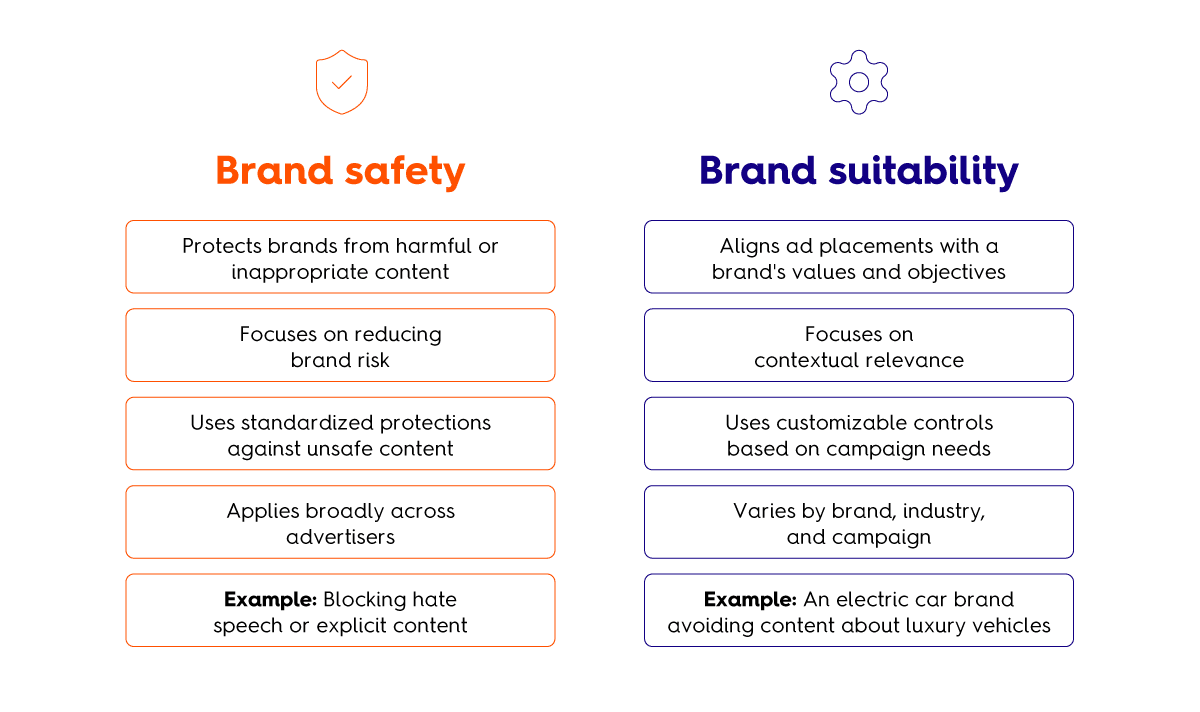
Although they’re often used interchangeably, brand safety and brand suitability serve different purposes.
Brand safety establishes a baseline by helping advertisers avoid content that’s broadly considered unsafe. Brand suitability helps advertisers determine which otherwise safe environments best align with their brand values, campaign objectives, and audience.
For example, a brand promoting electric vehicles may choose to avoid content about luxury sports cars or heavy-duty trucks. Those environments aren’t inherently unsafe; they simply may not be the best fit for the campaign.
Why safe ad environments matter
Brand safety helps advertisers protect consumer trust, make better use of media spend, and deliver campaigns that perform consistently across channels. A strong brand safety strategy can help advertisers:
- Protect consumer trust by avoiding placements that could undermine confidence in the brand or create unintended associations.
- Reduce wasted media spend by preventing ads from appearing alongside low-quality content or invalid traffic.
- Manage cross-channel risk by applying consistent protections across display, video, CTV, audio, apps, and social.
- Balance protection with performance by safeguarding brand reputation without unnecessarily limiting campaign reach.
Because digital content changes constantly, brand safety isn’t something advertisers can simply set and forget. Effective strategies require ongoing monitoring, regular optimization, and the flexibility to adapt as campaigns, content, and consumer expectations evolve.
Common brand safety risks advertisers face
Not all brand safety risks are equal. Some content discusses sensitive topics in an educational, journalistic, or informational context, while other content may contain graphic, explicit, or harmful material that poses a greater risk to brand reputation.
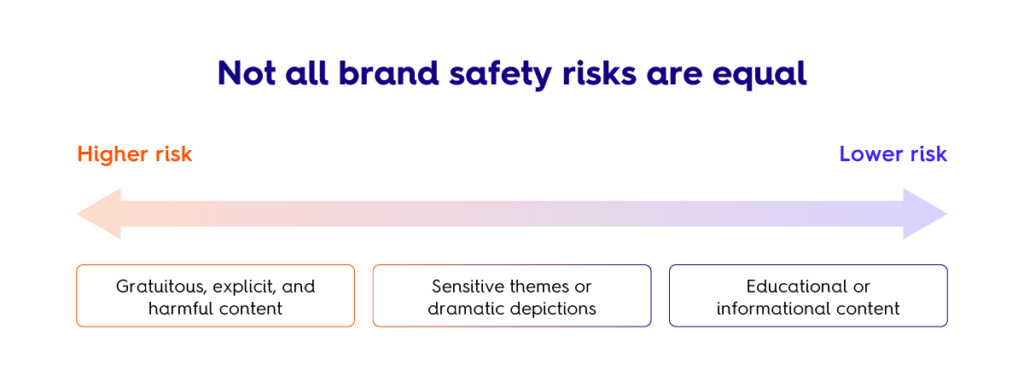 Context is what determines risk. The same subject matter can be a liability in one execution and entirely appropriate in another, which is why blanket category exclusions usually remove far more inventory than the risk justifies. Advertisers who set different protection levels across risk tiers are able to keep more of the reach they’re paying for.
A second kind of risk: Inventory that shouldn’t have been bought
The risks above are about what your ad appears next to. A separate category is about whether the placement had value in the first place. Made-for-advertising sites and low-effort AI-generated content are designed to attract impressions rather than readers. The content is rarely offensive, so it clears most brand safety settings without issue, and the spend disappears into inventory no one meaningfully saw.
This is why brand safety and media quality have converged. Advertisers evaluating only for harmful adjacency will pass inventory that poses no reputational risk and delivers no return.
How Criteo helps advertisers protect their brands
Criteo helps advertisers balance brand safety with campaign performance through configurable controls across domains, apps, inventory categories, geographies, SSPs, and campaign settings. Advertisers can tailor where their ads appear using inclusion and exclusion lists, category controls, and tiered protection settings that align with their brand standards and campaign goals.
Behind the scenes, Criteo applies additional safeguards across its advertising ecosystem. Supply Partner Guidelines help prevent ads from appearing alongside harmful content, malicious activity, or intrusive ad experiences, while global inventory controls are used to block inventory sources and remove publisher partners that don’t meet Criteo’s standards.
Criteo also partners with MRC-accredited DoubleVerify to provide active pre-bid, page-level brand safety protection across global web and app inventory.
These layers, including proprietary technology, independent verification, and human oversight, help advertisers reduce risk while maintaining access to high-quality, scalable inventory.
Best practices for protecting your brand without limiting reach
One of the biggest challenges in brand safety is overblocking. When safety settings are too restrictive, advertisers can unintentionally exclude quality inventory, reduce campaign reach, and miss opportunities to connect with relevant audiences.
The goal isn’t to eliminate every potential risk. It’s to apply the right level of protection in the right environments, balancing brand safety with campaign performance.
A more effective approach is to layer multiple controls rather than relying on a single tactic. Consider these best practices:
- Lead with contextual analysis, not keyword blocking. Keyword lists can’t tell the difference between a news report about a crash and content celebrating one, so they strip out quality inventory while missing the placements that actually create risk. Contextual analysis reads the surrounding content and makes that distinction.
- Tier protection by category instead of applying one setting across the buy. Set your strictest controls on the categories where your brand carries the most exposure and loosen them where it doesn’t. A single protection level applied uniformly is either too permissive somewhere or too restrictive everywhere.
- Layer control types rather than leaning on one. Domain, app, category, and geography controls each catch different things. Combining them gives you tailored protection without pushing any single lever to a setting that costs you scale.
- Treat lists as a supplement, not the strategy. Blocklists are useful for known problem environments and allowlists are useful for guaranteed-quality buys, but running on lists alone caps your reach at what you already knew about. Prioritize trusted publishers and verified inventory, then let contextual controls handle everything you haven’t manually reviewed.
- Audit blocked placements on a schedule. False positives are invisible unless you go looking for them. Reviewing what your settings excluded, and how much inventory that represented, is the only way to know whether your protection level is calibrated or just conservative.
No brand safety strategy can eliminate every risk. The most effective programs combine thoughtful controls, continuous monitoring, and regular optimization to protect brand reputation while maintaining campaign performance.
Your checklist for brand-safe campaigns
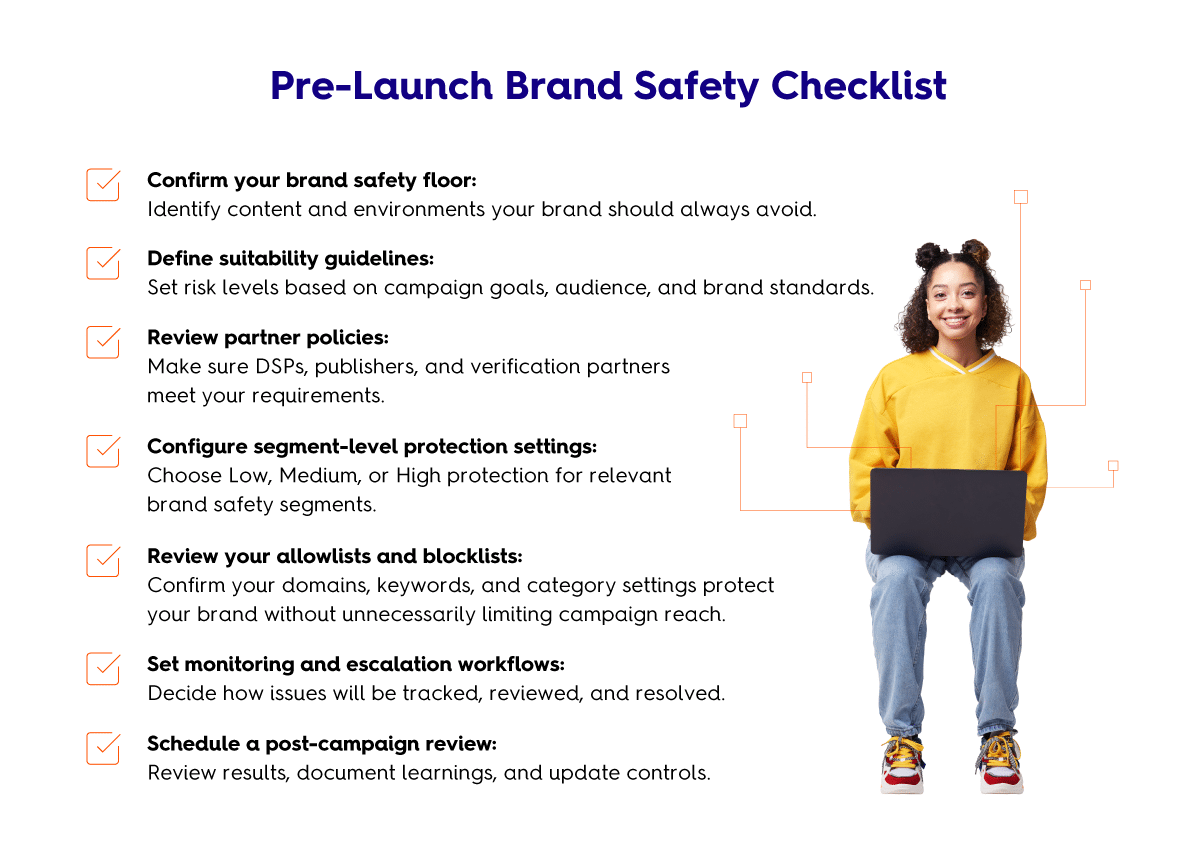
Before launching a campaign, advertisers should confirm that the right safeguards are in place to protect both brand reputation and campaign performance. A simple pre-launch checklist can help prevent avoidable issues and create a more consistent approach to brand safety across campaigns.
 Put brand safety into practice
Brand safety is essential to protecting consumer trust without limiting campaign performance. With clear standards, tiered protection, monitoring, and human oversight, advertisers can reduce risk while preserving access to relevant, scalable inventory.
Ready to protect your brand without limiting reach? Learn how Criteo helps advertisers balance brand safety, campaign scale, and performance across the open internet. Contact us to speak with an expert.