






For a couple of decades now, online shopping has followed a similar pattern.
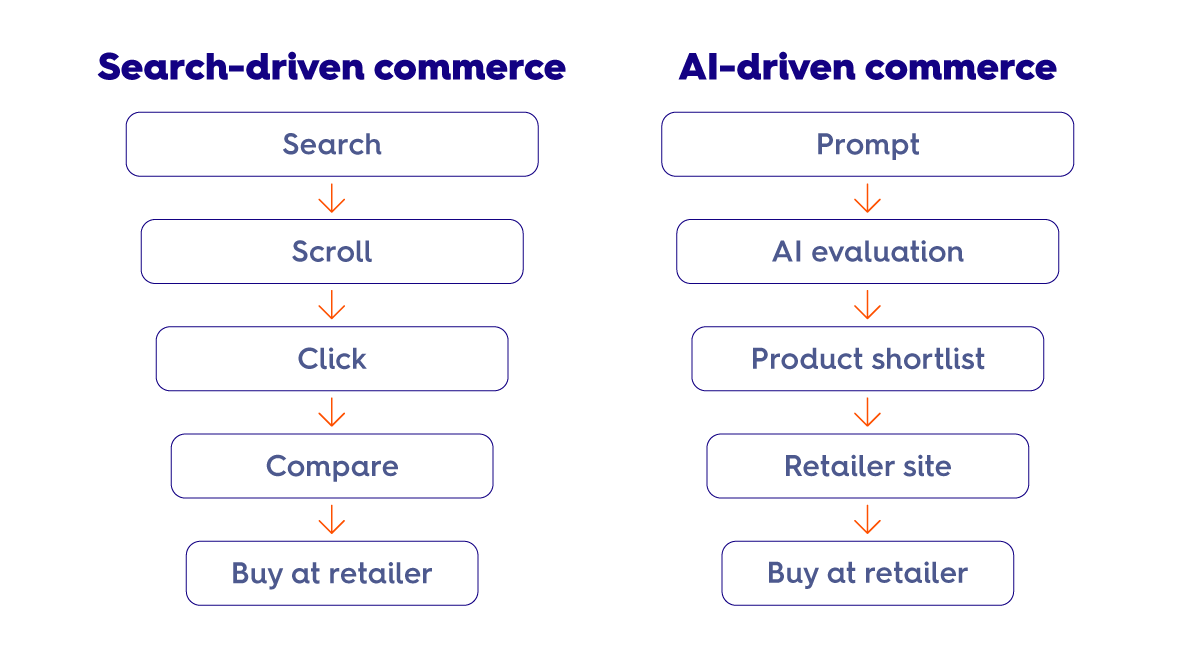
Search, scroll, click, compare, buy.
It’s a flow we’re all familiar with.
It’s also a flow where the shopper does most of the work: searching, sorting, filtering, comparing—maybe a little second-guessing—and eventually buying a product. Brands compete for visibility on the page: in organic results, rankings are determined by relevance and product performance, while in sponsored results, the top slot goes to whoever bids the most.
This paradigm is here to stay. But in the AI era, a new dynamic is emerging alongside it.
What is the commerce knowledge gap?
Shoppers are increasingly handing the time-intensive work of discovery and comparison to AI assistants.
The shopper writes a quick prompt (‘What are the best running shoes I can buy for $150?’), the AI evaluates, and a shortlist appears. No scrolling, no search results page. Just a set of products the AI has chosen to recommend.
But here’s the thing about that shortlist. It’s visible to the shopper, but the commerce signals that shape it are often absent.
That’s what we call the commerce knowledge gap. It’s the space between what AI assistants can easily see and the real-time commerce signals they need to make accurate, relevant, and useful product recommendations. There’s no mystery about where this data lives: it’s the preserve of retailers and brands.
The missing piece is access.
As wide as an ocean, as deep as a puddle
When Large Language Models arrived, it was easy to assume they had infinite knowledge. Over time, it’s become clear that it’s not quite that simple.
Today’s LLMs are well-equipped to read the surface of a product: titles, descriptions, specs, reviews, images, and so on. They make recommendations based on this visible layer constantly. But the deeper commerce signals that determine which product actually deserves to be recommended, and why, sit beyond what LLMs can reach on their own, unless a retailer or commerce platform explicitly grants that access.
This matters enormously for brands. An AI recommendation is only ever as good as the data behind it. Strip away deep commerce signals and discovery becomes shallow at best, and simply wrong at worst. It defaults to high-level signals like popularity, reviews, and whatever else the LLM can most easily surface.
The urgency is compounded by one simple fact: AI-assisted shopping is growing quickly. The data makes this clear:
- LLM-referred shoppers convert at roughly 1.5x the rate of other referral channels.
- AI traffic to retail sites grew 693% year on year during the 2025 holiday season, the highest growth rate of any industry.
- Albertsons has reported that shoppers who use its “Ask AI” assistant deliver 10% larger basket sizes.
- 70% of AI-referred retail traffic now lands directly on a product detail page, up from 50% a year ago.
How do brands stay visible when AI controls the shortlist?
In the traditional ecommerce model, the digital shelf is the search results page: hundreds of options, ranked by some combination of relevance, stock availability, paid placement, and shopper signals.
AI-driven discovery works differently.
With no results page to optimize for or bid on, visibility depends on whether AI assistants can access the right commerce data: structured product information, enriched attributes, current availability, pricing, transaction signals, and real-time verifiable data. The brands and retailers that invest in clean, connected commerce data today are building the foundation for AI presence tomorrow.
If the AI can’t verify those underlying commerce signals, the consequences are predictable: either the product doesn’t surface at all, or it surfaces with outdated or incorrect details. Maybe the shopper clicks through to find the item out of stock. Maybe the price has changed. Either way, the moment is lost.
What AI agents can see (and what they can’t)
LLMs are essentially blind to the operational realities of commerce.
What they see is the surface: product descriptions, brand names, colors, customer reviews, public attributes, and so on.
What they often can’t see is the deeper commerce signals that matters to a real shopper who just wants to buy the right product at the right price:
- Is the product in stock locally, right now?
- Did the price just drop dynamically for a flash sale?
- How popular is it, and does it sell more frequently than similar products?
- What other products are shoppers frequently buying alongside this one?
- What kind of offsite research and review behavior is signaling intent to buy?
- Is this item frequently returned, or do shoppers keep it?
None of this is visible to an LLM by default. Without it, the recommendation is compromised before it’s even made: which product to surface, whether a substitute is relevant, what complementary items belong alongside it, and whether the shopper is genuinely close to buying.
The recommendations that follow are often a regression, not a progression: blunter, shallower, and less useful than what a well-structured commerce data layer already makes possible.
What Criteo knows about commerce
We’ve spent the last two decades building and refining one of the world’s largest open commerce data sets. That gives us visibility into the commerce signals AI assistants can’t reliably access on their own.
There’s more detail on what commerce data is and why it matters, but the critical point here is why the right data matters so much for an agentic world. When AI-assisted shopping began to ramp up, we tested LLM capabilities against our commerce intelligence engine. The results were striking: feeding in our real-world shopping signals improves AI recommendation relevancy by up to 60%.
Crucially, this isn’t a channel we built for LLMs. It’s the foundational data already driving $40 billion in annual sales across our platform. Across all 5 billion products in our network, we pair visible data like taxonomy, descriptions, and public attributes with the deeper commerce signals LLMs can’t access alone: 38,000 daily feed updates, real-world transaction outcomes, Shopper Graph intelligence, popularity patterns, returns behavior, and offsite signals like publisher reviews and research patterns that indicate buying intent.
This is the complete commerce picture an AI assistant needs to make recommendations that are actually useful. And Criteo’s role is to bridge it: connecting the deep commerce intelligence that drives $40 billion in annual sales directly to the LLMs where consumers are increasingly going to discover and buy products.
Getting day one ready
Preparing your brand for agentic AI doesn’t mean hiring engineers or building complex APIs into every major LLM.
It does mean focusing on the structure and quality of your commerce data, and partnering with someone already embedded in the AI platforms where discovery is happening.
At Criteo, we’re building multiple paths to this future. That includes our Agentic Recommendation Service, our Dynamic Creative Optimization solutions, our integration with OpenAI’s ChatGPT Ads, and the partnerships we’re forging with retailers to help them prepare for AI-driven commerce. Our job is simple: to make sure your products show up, accurately, where shoppers are spending time (and money).
The players that win in AI-assisted commerce won’t be the ones racing to integrate with every LLM. They’ll be the ones whose data is already represented by a partner that has.