





Whether or not Henry Ford actually said “If I’d asked people what they wanted, they would’ve said ‘faster horses’” is debatable.
And yet I think about that quote often, because it captures something deeply human: the instinct to improve what we already know rather than question whether we’re solving the right problem.
It’s classic “if it ain’t broke” thinking. And I see it everywhere in how our industry is approaching AI-powered audience targeting right now.
The marketers I speak to have added AI to their audience targeting workflows. It’s a logical move – the tools are better, the data inputs are richer, the optimization is faster. Yet customer acquisition cost continues to rise.
That’s because the question most of us have been asking is, “how can AI make our existing targeting more efficient?”
A more fundamental question is: what happens when AI redefines what targeting actually is?
I think there are two parts to the answer, and both involve rethinking what we ask AI to do: the signals we feed it, and the holistic system we build around those signals.
Let me start with why the existing model is running into a ceiling, even with AI layered on top.
The targeting ceiling your AI can’t fix
Audience targeting often follows a familiar pattern.
You build a profile of your ideal customer based on what you know about existing buyers: age, income, location, interests, maybe some browsing behaviour. You push that profile through a platform, the platform finds people who match, and you optimize for performance within that frame.
Demographics still matter. Knowing your customer’s age, location, and income bracket gives you a starting frame – and for plenty of campaigns that frame works well enough.
Where it runs into trouble is precision. Two couples in their early 30s, similar income, same postcode, can have completely different shopping behavior depending on whether they have kids. One is buying strollers and baby formula. The other is booking weekend trips and buying wine subscriptions. A demographic profile sees the same person. Commerce data sees two entirely different lives.
Or take a brand like Coca-Cola. They could target almost anyone. But ‘anyone’ doesn’t make people feel like an ad was meant for them. The more universal your product, the more you need behavioral signals to find the specific moment and context where your message connects.
Demographics tell you who someone looks like. Commerce signals tell you what they’re actually in the market for. The strongest targeting uses both, but when brands rely on demographics alone, they end up bidding on the same broad profiles as every competitor in the category.
| Traditional approach | Commerce signal approach | |
|---|---|---|
| Signals | Static: age, income, gender, location, interests | Commerce-intent signals: what people actually browse, cart, and buy in the last 90 days |
| Segment creation | Pre-defined segments that broadly match a customer profile | AI-powered audiences built uniquely to the brief using observed customer behavior |
| Scale | Broad reach, but weaker at separating people with active purchase intent | Scaled with precision: higher quality demand from people showing real purchase intent |
This matters especially right now because the market itself is shifting.
BoF and McKinsey research shows fashion moving upmarket at every price tier: value brands pulling SKUs from their cheapest brackets, mid-market introducing premium lines, luxury prices up roughly 60% since 2019. That creates a wave of repositioning, and when positioning shifts, the audience needs to shift with it.
Brands like Mango, COS, and H&M are making smart moves upmarket, introducing premium lines, investing in quality, and shifting their price architecture. It’s a well-documented trend, and for good reason.
For any brand repositioning like this, there’s a targeting question worth asking: are you actually reaching new, higher-purchase-power customers, or are your existing buyers just spending more? This is where commerce signals become foundational. What people actually browse, add to cart, and buy is a better foundation than proxies and assumptions.
The patterns that matter most are the ones you’d never think to look for
Even when brands move beyond pure demographics, they tend to target based on patterns a human planner would think to build: categories and interests that feel logically connected to their product.
The most valuable audience signals are often non-obvious. They emerge from commerce behavior at scale.
Here’s a great example of this I’ve seen in commerce data: if you’re a beer brand targeting “new dads,” a demographic approach might give you men aged 28–38 with an interest in parenting.
Commerce data tells a different story. At scale, this group clusters across nappies and strollers, premium beer brands like Sapporo, Heineken, and Leffe, and sports and lifestyle media like GQ Men and Men’s Health Online.
A beer brand, a baby brand, and a men’s lifestyle publisher are all competing for the same person’s attention, and none of them would know it from a demographic profile.
That’s the pattern at scale: commerce data surfaces relationships between products, touchpoints, and shopper groups that nobody would think to look for.
Your best-performing audience for the next campaign might not resemble your existing customers at all.
Case in point: brands activating prospecting audiences built on commerce data have seen increases of as much as 37% new customers compared to traditional targeting approaches.
From segments to signals to systems
So what does rethinking the process look like? I think it happens in two layers.
Target based on real commerce signals, not assumed segments
Commerce data means signals from actual transactions: what people search, view, add to cart, and buy across thousands of sites. Four things matter in these signals:
- Precision (how granular is the behavior data)
- Scalability (how broad is the coverage)
- Freshness (how recent are the signals)
- Comprehensiveness (how many data points feed the model)
Let’s take the example of a skincare brand. Commerce data may well show you that your highest-converting new customers also buy running gear and meal prep products.
The audience is defined by a lifestyle, not a product category. No assumption-based model would have surfaced that.
And for brands in the middle of repositioning (the BoF trend I mentioned earlier), commerce data answers the question assumptions can’t: did we actually reach a new type of customer, or are we showing the same people a more expensive product?
Build the system, not just the audience
Here’s where things get interesting.
To my mind, the future of AI-powered targeting is less about running individual campaigns and more about training AI-powered systems to find customers.
Think about how the brief itself changes.
- The traditional brief was: “Target this predefined audience based on how I think my shoppers look.”
- The AI-native brief becomes: “Help me sell more of these products. Figure out how.”
My colleague Alejandro Rodríguez Martín phrases it spot on, the AI-native approach would be: “Maximize ROAS across 26 markets. Figure out how.” That’s the brief. The system figures out the targeting.
What makes this fundamentally different from bolting AI onto existing workflows is that targeting stops being a clean, isolated step you complete before launch. The system combines commerce signals, creative, and context into a prediction model that continuously optimizes.
There’s no discrete “define the audience” moment, followed by “launch,” followed by “analyze.” It’s happening together, all the time.
The marketer’s role changes accordingly. You’re setting strategic guardrails: what are the goals, where’s the line between broad reach and quality demand, what inputs does the AI need to work with?
Straightforward goals (traffic, conversions, ROAS targets) can let the system run with more freedom. More complex setups, where you’re factoring in existing customers, returns, and lifetime value across different customer groups, need the marketer to actively set the frame.
First-party data becomes even more critical in this model. The system is only as good as what you feed it. Last purchase date, average order value, full-price versus discount buyers, return rates: this is what helps the model understand who your best customers actually are, who’s likely to convert next, and who’s drifting away.
Your targeting might be smarter. But is it smart enough?
In practice, signal-based targeting draws on three layers of input:
- The products available across a DTC brand’s catalog
- Product interactions happening in real time (what people search for, view, add to cart, and buy)
- Identity signals that connect those behaviors to real individuals
The system reads patterns across all three to surface audiences you wouldn’t have found manually, including segments that span category boundaries.
Predictive audiences illustrate what these systems can do well, and the concept is straightforward: you start with a seed. Take your best-performing customers – however you define ‘best’ – and the system finds more people who behave like them.
What makes this powerful is that the seed can be anything. Likely churners you want to win back before they drift. Fast converters who buy within days of first contact. Full-price buyers versus discount hunters. Early adopters who consistently try new product lines. Repeat customers with high lifetime value and low return rates.
Each of those is a different audience, built from a different seed, serving a different business objective. And because they’re built on observed commerce behavior rather than assumed profiles, they get more precise as the data gets fresher.
Four questions worth asking whoever runs your targeting:
- Can it surface audiences you wouldn’t have thought to build yourself?
- Can you see what’s actually inside a recommended audience, the demographics, shopping behaviors, and content consumption patterns, before you activate it?
- How does it handle the tension between precision and scale? Deeply precise audiences are valuable, but if they can’t scale, they won’t deliver results.
- How do you measure the real impact? Make sure you’re using the right attribution model, testing incrementality, and comparing vendors against each other.
Looking ahead, the next evolution is unified decisioning.
Right now, most brands run separate audiences with separate budgets on each channel, each optimizing in isolation. The more advanced model brings all of this under one strategy, with AI optimizing across social, CTV, open web, and cookieless environments.
Why this matters: a consumer browses on Safari, scrolls through social, and purchases in-app. If your system loses the signal every time they cross an environment boundary, you’re making decisions on an incomplete picture. The best targeting systems pick up signals across all of those touchpoints, not just the ones where tracking is easy. The intelligence layer then decides which audience to prioritize, where to reach them, and how to allocate spend based on performance across the whole system, thus focusing on the shopper journey, rather than individual channels.
A word of caution though – this kind of system can’t be a black box.
The audience segments it creates need to be legible beyond a simple label. Decisions need to be traceable. The marketer’s role in setting strategy, defining the frame, and validating what the system produces doesn’t go away. If anything, it becomes more important.
The brands building signal-based foundations now will be best positioned when unified decisioning matures.
The four layers behind continuous audience optimization
The diagram below shows how these layers connect.
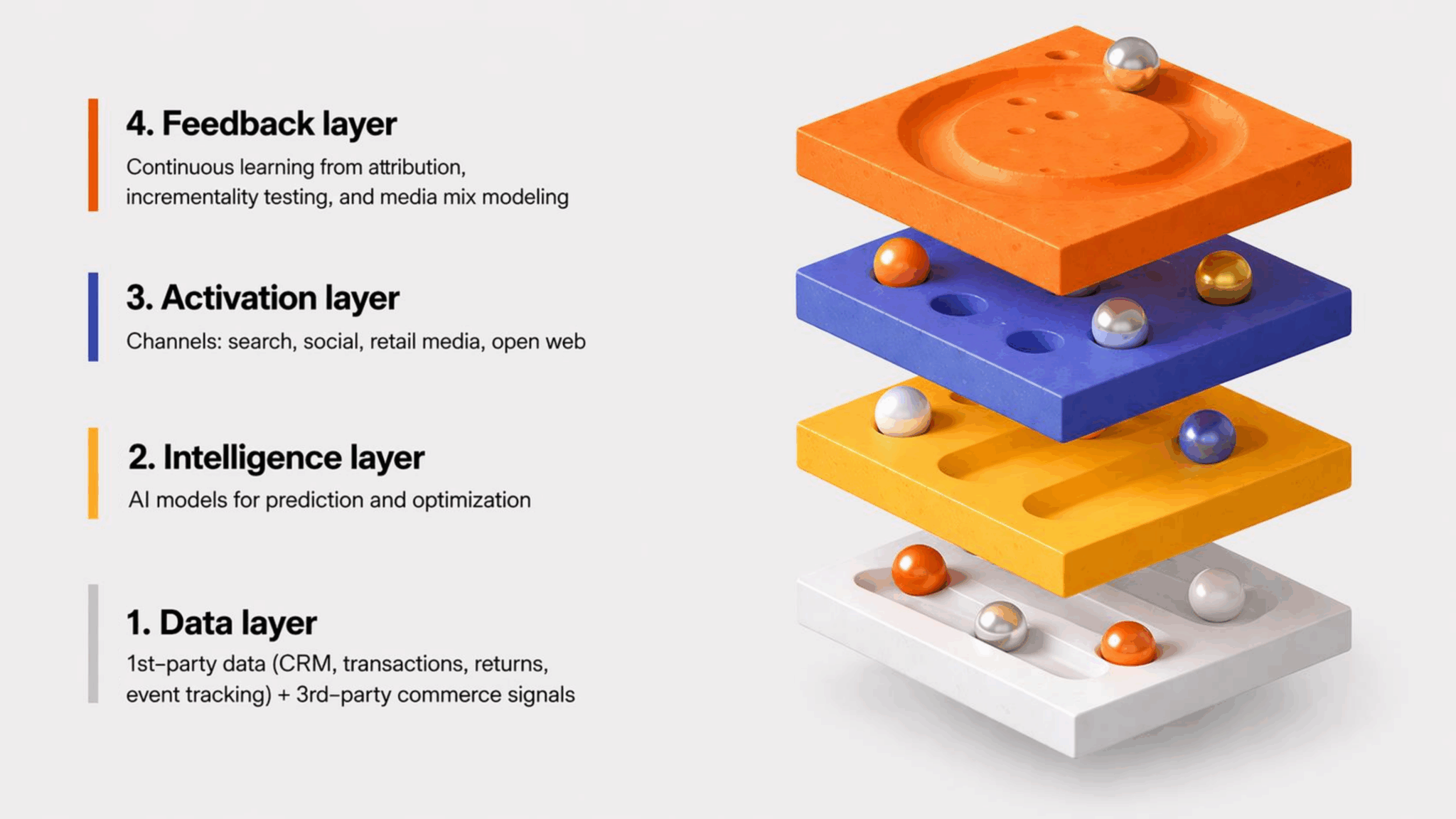
The point: audience targeting in this model is a continuous learning system, not a single step in campaign setup.
The 10% budget test that proves the point
If you’ve built CRM segments, defined audiences, and invested in first-party data, you’re in a stronger position than you might think. That data is a genuine asset, especially for mid and lower funnel campaigns where you already know who you’re trying to reach.
Activating it alongside commerce signals is one of the highest-impact moves a brand can make right now.
The practical first step: take 10% of your campaign budget and apply it to audiences built on commerce signals. Run it alongside your existing targeting and compare the results week by week. Test a couple of different audience strategies, compare the results, and adjust budget accordingly.
The bigger step is connecting those signals to a system that works across the full funnel.
Look for a platform where AI optimizes targeting, creative, and spend together, from awareness through to conversion, across every environment your customers move through. That’s where the compounding advantage lives: not just better audiences, but a single system that gets smarter with every campaign. The faster horses phase got us here. The next phase is where we progress to autonomous vehicles and beyond.
Activate your first-party data alongside Criteo Commerce Audiences and let our AI find your most valuable shoppers.